– 10 –
Monday, March 18, 2019
That weekend I had taken Cam’s suggestion and not done any school work. It was wonderful, really, because we had the time to catch up on some Netflix, play lots of My Little Pony, and just enjoy each other’s company.
I arrived at school about an hour early to grade the essays I had ignored all weekend. As I sat at my desk to check my email, I was not exactly happy to see a message from Brandon’s mother with the subject line: “Suspension.”
My heart sped up as I considered whether I should open the email now or wait until my third period prep time. Before I could consider it further, my finger made a decision of its own and clicked.
Dear Miss Rein Thompson,
Brandon was suspended yesterday for what he said to you in your English class, and I want you to know that while we do not condone him disrespecting his teachers, we fully support his First Amendment right to hold his views and not be forced to deny them. His father and I have advised him to not bring it up again unless provoked. His chance at a basketball scholarship cannot be further hindered by additional suspensions.
Mrs. Marjorie Stoneman
First Amendment right? I guessed it had been a while since I had read the Constitution, but I didn’t remember it allowing people to just be assholes to each other. I sighed and reread the words—not apologetic but not technically rude. Not warm but not accusatory. I was going to have to accept it. I began typing.
Dear Mrs. Stoneman,
I appreciate your message. But you can go to hell.
I smirked and then hit the backspace button a few times.
I appreciate your message. In my class, I encourage students to use words to speak the truth, but they must do so in a respectful way. Thank you for your support in this matter.
Mrs. Rein-Thompson
There. Now no one could accuse me of forcing my “lifestyle” down anyone’s throats or violating anyone’s Constitutional rights.
My classroom door opened, and I expected to see Dana standing on the other side of it; instead, I saw Kate holding a piece of paper. She was wearing a red and blue Benson High hoodie that practically swallowed her whole.
“Oh,” Kate said, startled, “I thought I would just put my essay on your desk. I didn’t expect you to be here this early.”
“It’s okay, Kate. Good morning.” I gave her a small, closed-mouth smile. “I was actually just getting ready to grade some essays, so yours can be first.” I reached out my hand for the paper.
Kate shifted her weight from one foot to the other, keeping her eyes on her essay. “Sorry mine is a day late. Remember when I had the flu last week? I got a little behind.”
“I know. I figured you needed some extra time.”
She walked to my desk and handed me the essay without making eye contact.
“See you fifth period,” Kate said quickly before darting out the door.
I sighed again, worried that Kate felt awkward after writing about me—to me—in her journal on Friday. I wondered if I should have said something encouraging to her just then but then considered whether that would have made it worse. Deciding to just move forward as if it hadn’t happened—as if none of it had happened—I would forgive Brandon and pretend like Kate didn’t know a thing.
I looked down at Kate’s essay and reread the assignment prompt typed on top of her outline paper: “In honor of Women’s History Month, write an essay about a woman who has had a positive impact on your life.” I love doing this assignment and reading all about students’ moms, grandmas, and older sisters, and there are usually a few about Beyoncé or a Kardashian or whatever female celebrities are currently popular. In tenth grade, I would probably have written about Grandma Louise or Madonna. I wondered how I would have chosen which one.
Resigning myself to do what I had come early to do, I settled into my chair to get more comfortable for an essay-grading shift and began reading Kate’s opening paragraph:
There have been many positive females in my life. I am lucky to have two living grandmothers and a mother who loves me. I even have a few neighbors that I could have written about but I am choosing to write about Mrs. Rein-Thompson.
I stopped reading and looked up, surprised. I had been teaching for thirteen years and had used this prompt every March, and no student had ever written about me before. I felt honored but also undeniably nervous as I continued reading Kate’s thesis statement:
She has had a positive impact on my life because she is kind, successful and true to herself.
I began to smile to myself and then froze when I realized what that last part might mean. Had Kate actually written about my sexuality in her essay? This could get interesting.
First, Mrs. Rein-Thompson is kind. No matter what kind of day she is having she always has a smile on her face and is willing to help any student in her classroom. She must be in a bad mood sometimes but she never shows it. I have seen her go out of her way to talk to kids in the hallway and have even seen her help other teachers when they need it. This has inspired me to be nicer to people too.
Next she is successful. She always talks about how writing is her favorite thing to do and she made a career out of it by being a writing teacher. I think that success is defined by doing something that makes you happy and also makes you money and that is exactly what she is doing. I want to be just like that when I get older.
The classroom phone rang, and I jumped. “Hello?” I answered, forgetting to identify myself.
“Good morning, Josie.” It was my principal, Mr. Dunham. “Can you stop by my office during third period? I’d like to talk to you about something.”
“Sure,” I said uncertainly. “Is this about Brandon? He’s back today, right?”
“Yes, he is.” He hesitated. “And I guess you could say it’s related. See you then.”
I sat with the phone in my hand for a few seconds after he hung up, wondering what the issue could be now.
The bell rang for first period to begin, and my students started filing in. I blinked a few times to center myself and silently repeated my pep talk: “This is what you’re good at. This is what you can control.” As the late bell rang, I wished my students good morning and told them to take out their journals.
“Next week,” I began, “we will begin reading excerpts from the novel titled Red at the Bone by Jacqueline Woodson. I won’t give too much away, but much of the story deals with identity—that mixture of who we are, who we think we might be, and who we wish to be. In your journal today, write about one or more of those things.” I wrote on the board:
Who do you think you might be? Who do you wish to be? Who are you really?
I would leave the prompt up for the rest of the day for all of the classes to write about. After I had finished writing it, I wondered how Brandon would respond in his journal. Would he admit to being a bigot? I thought that might be too harsh of a word for him. Plenty of kids at that age don’t even have opinions of their own yet and are still regurgitating the ones that belong to their parents.
While my students wrote, I considered how I would answer the questions myself. I mentally recited, “I think I might be a good person. I wish to be creative and kind. I am actually invisible.”
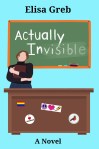
 Actually Visible